Private Investigator

Graphic by Alondra Pulido
Private investigators (PIs) may work for fraud departments in state and federal government agencies, or work with law firms to help in the discovery process. Their primary responsibility is to dig up evidence to support their client’s case. Although many have backgrounds in military or police enforcement, there are also PIs who have backgrounds in law. Such a background grants PIs a strong understanding of what lawyers need to be successful in their case. A legal background is also helpful for PIs in regards to client relations, as many of their clients are brought to them through their lawyers.
The requirements to become a private investigator are not particularly restrictive in Washington state. Besides filling out an application and paying a fee, the only other requirements are: being over the age of 18, being a U.S. citizen or resident alien, not having a criminal record, being employed by a private investigator agency, and submitting a set of fingerprints. Formally, there are no educational requirements, though a J.D. can make a PI applicant more desirable to a hiring agency. Additionally, different agencies may have different education requirements.4 There are also separate licensing requirements for becoming an armed private investigator and to run a PI agency. In addition to these licensing requirements, prospective PIs also are required to take and pass an exam administered by the Washington Department of Licensing.
Private investigators are commonly hired by lawyers to assist with cases by performing background checks on their clients and witnesses. Also common, PIs may be hired by lawyers to assist in digging up evidence in family law cases, especially those surrounding divorce and questions of infidelity. Their primary duties in these cases involve interviewing people related to the case, searching online and public records to uncover and collect evidence, and conducting surveillance. However, because PIs lack police authority, they must follow the same laws as a private citizen as they conduct their investigation.

Background image by Volodymyr Hryshchenko on Unsplash
Puppy Dubs II image from Washington Athletics
Current undergraduate students and those who do not wish to complete their J.D., but who still wish to pursue a legal education may choose to attain a Master of Jurisprudence (M.J.) from the University of Washington. Additionally, current PIs unsure of whether they want to commit to a 3-year J.D. program and that believe that legal knowledge would be beneficial to their current profession may also choose to pursue the program. Because private investigator positions do not require a J.D., and because the program allows students to take classes in the law (knowledge that is tested on the PI exam), the M.J. is a good fit for those wishing to become a private investigator without a J.D.
Sources
-
Career Alternatives for Attorneys: Private Investigation / Business Intelligence [Above the Law]
-
How to Become a Private Investigator in Washington [Private Investigator]
-
Master of Jurisprudence (M.J.) [University of Washington School of Law]
-
RCW 18.165.030, Private Investigator License—Requirements
-
What Private Detectives and Investigators Do [U.S. Bureau of Labor Statistics]
Video: Dream Jobs: Private Investigator
Books:
-
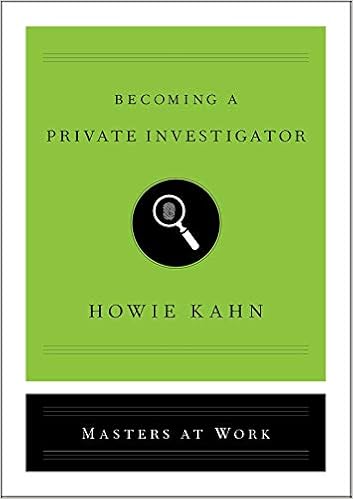 Becoming a Private Investigator
by
'Becoming a Private Investigator' puts a seemingly out-of-reach profession within the your grasp. Weaving practical how-to advice with inspiring case studies, Kahn provides actionable steps anyone can take to pursue a career as a P.I. as he shadows two experienced American P.I.s, Sheila Wysocki and Mark Gillespie, both of whom are investigating a series of deaths about which many questions remain. What skills must they master to find out the truth? What risks must they take to succeed? In a narrative full of shocking details, 'Becoming a Private Investigator' sheds light on the professionals who fight for justice and change the lives of others forever.
Publication Date: 2019
Becoming a Private Investigator
by
'Becoming a Private Investigator' puts a seemingly out-of-reach profession within the your grasp. Weaving practical how-to advice with inspiring case studies, Kahn provides actionable steps anyone can take to pursue a career as a P.I. as he shadows two experienced American P.I.s, Sheila Wysocki and Mark Gillespie, both of whom are investigating a series of deaths about which many questions remain. What skills must they master to find out the truth? What risks must they take to succeed? In a narrative full of shocking details, 'Becoming a Private Investigator' sheds light on the professionals who fight for justice and change the lives of others forever.
Publication Date: 2019 -
 The Complete Idiot's Guide to Private Investigating
by
Publication Date: 2013Available online from O'Reilly Academic
The Complete Idiot's Guide to Private Investigating
by
Publication Date: 2013Available online from O'Reilly Academic -
An Introduction to Conducting Private Investigations: Private Investigator Entry Level by This book provides the essential tools you need to become a successful private investigator. From conducting straightforward background investigations to more complicated cases involving accidents and fraud, you will learn the critical skills needed to conduct all types of investigations and build a thriving business. Specifically tailored to meet the requirements established by the Department of Criminal Justice Services, this easy-to-use resource offers an excellent balance between theory and practice, and is the definitive guide for private investigation instruction.
Publication Date: 2013 -
 Private Security and the Investigative Process
by
Publication Date: 2010Available online from O'Reilly Academic
Private Security and the Investigative Process
by
Publication Date: 2010Available online from O'Reilly Academic